
Molecular Fingerprint: Polymer QC & Failure Analysis
In the modern plastics industry, high product quality at a competitive price is no longer a luxury, it is a mandatory requirement for survival. From automotive parts and electronic devices to sophisticated multi-layered packaging, polymers are the backbone of global manufacturing. However, as these materials become more complex, incorporating various polymers, fillers, and additives, the risk of production errors and material failure grows.
To achieve cost-saving production, manufacturers must move beyond traditional testing and adopt molecular intelligence.
Why Molecular Identity Matters
The journey to a high-quality plastic product begins at the loading dock. Verifying the correct identity of incoming raw materials is the first essential step for a trouble-free manufacturing process. Without this verification, manufacturers face increased waste, production downtime, and decreased customer satisfaction.
Fourier Transform Infrared (FT-IR) spectroscopy provides a "chemical fingerprint" of your sample. Just as no two humans share a fingerprint, the IR spectrum of a sample reflects its unique molecular composition, allowing for the rapid identification of both organic and inorganic components.
High-Efficiency Quality Control with ALPHA II
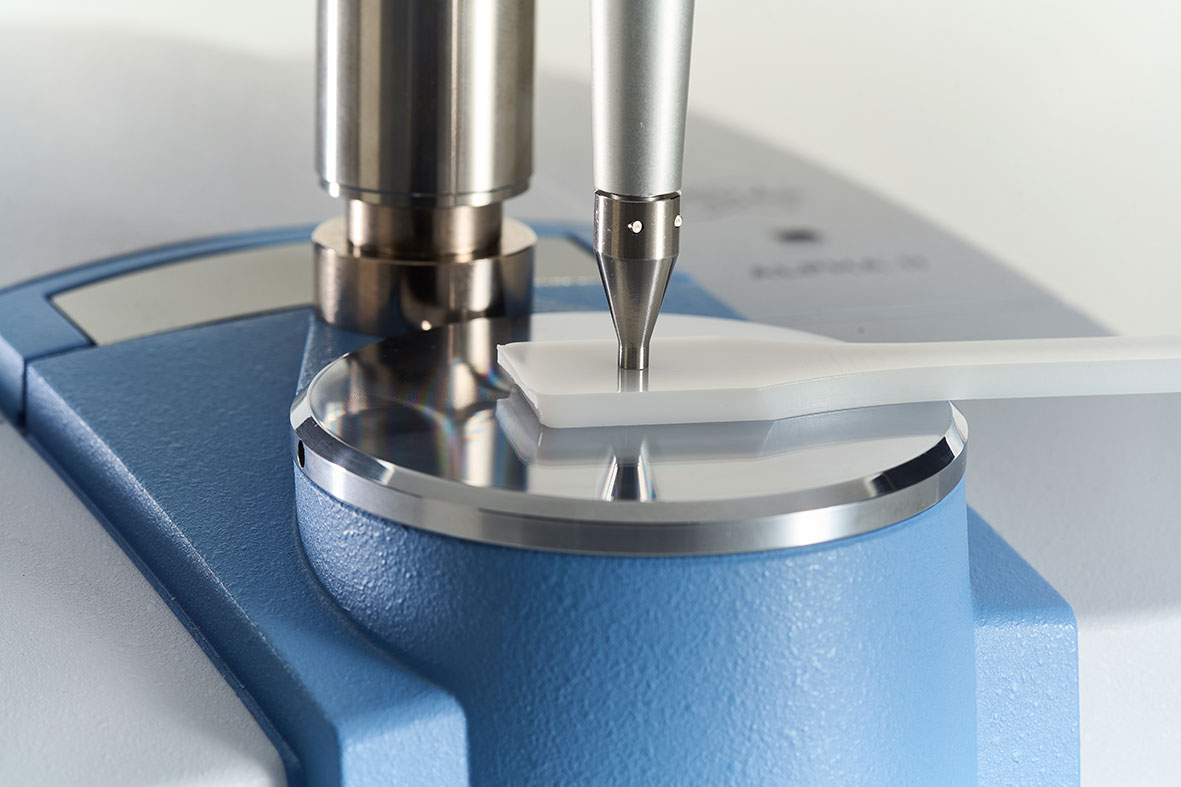
The Bruker ALPHA II is designed to bring this laboratory-grade precision directly to the production floor or warehouse.
Speed: Verify the identity and composition of any plastic product in less than one minute.
Ease of Use: An intuitive, guided workflow allows even untrained operators to perform measurements, evaluations, and reporting.
Zero Sample Prep: Utilizing Attenuated Total Reflection (ATR) technology with a robust diamond crystal, you can analyze pellets, films, powders, or liquids without consumables or complex preparation.
Robustness: The system is insensitive to vibrations and features automated instrument tests to ensure it always operates within specification.
Solving the Unsolvable: Microscopic Failure Analysis
Even with strict QC, product defects can occur. Inhomogeneous distribution of components, fibers, or microscopic inclusions (often called "black specks") can lead to catastrophic material failure.
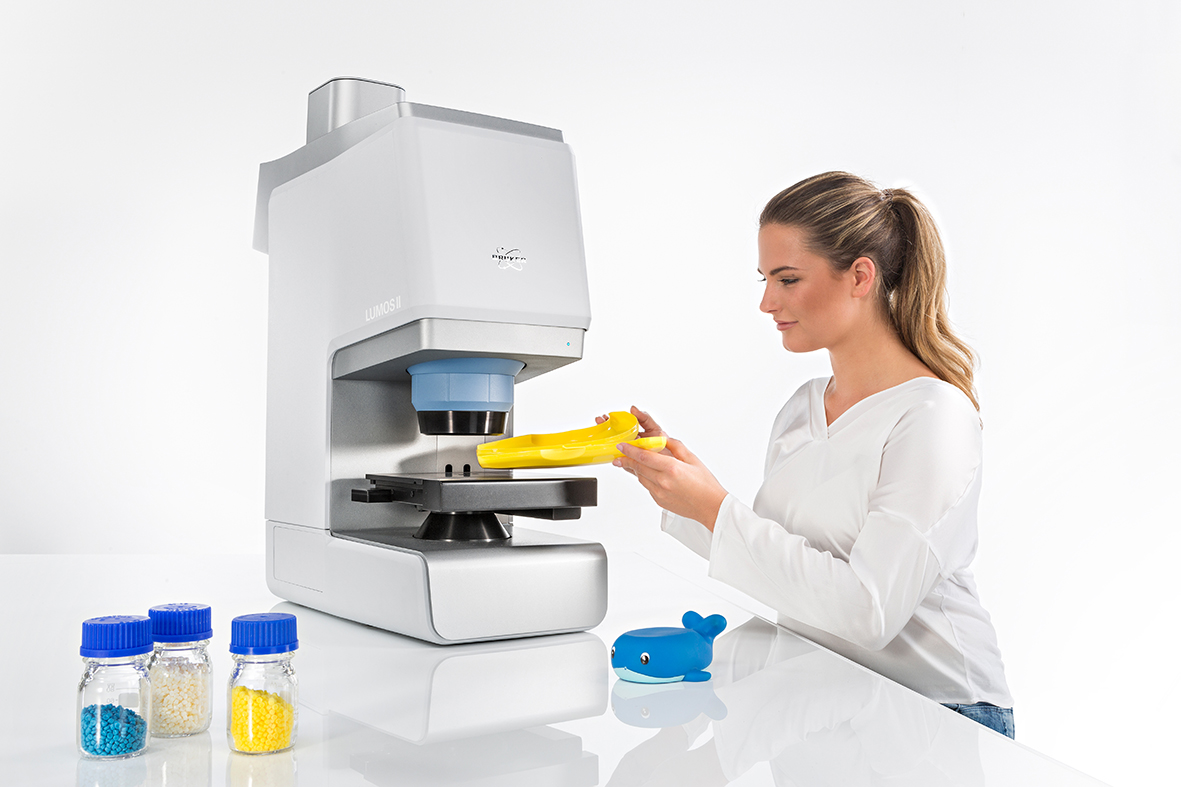
When these defects are too small for macroscopic analysis, the LUMOS II FT-IR Microscope becomes an essential tool for root-cause analysis.
Visual Precision: It allows users to obtain IR spectra anywhere on a sample with high lateral resolution to reveal the exact chemical composition of a faulty region.
Chemical Mapping: Mapping measurements can reveal the distribution of basic polymers, fillers, and plasticizers, helping to detect "self-contamination" from partly melted granules.
Case Study: A batch of polyethylene pellets containing unwanted brown inclusions was analyzed. While the matrix was confirmed as PE, the LUMOS II identified the inclusion as a polyester (PET) contaminant, allowing the manufacturer to trace the error back to the source.
Advanced Characterization: Beyond the Surface
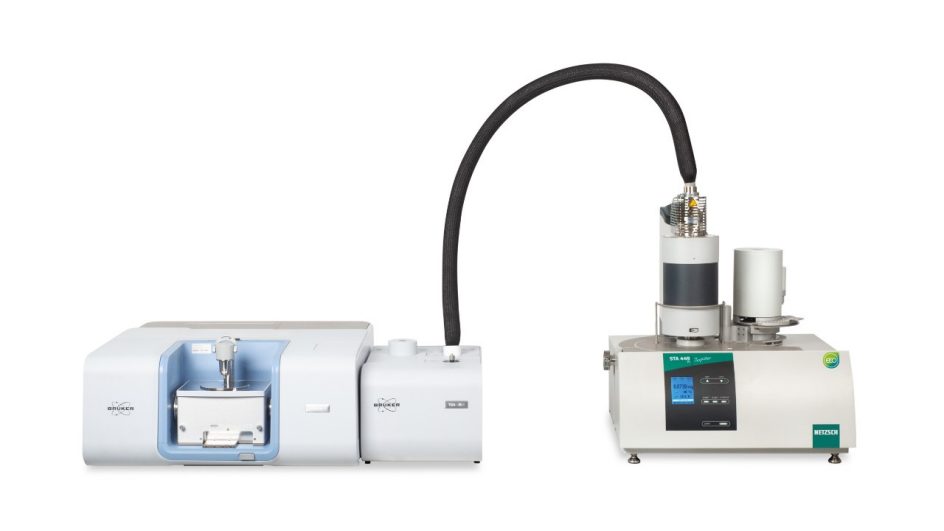
For R&D and advanced material development, understanding how a polymer behaves under thermal stress is critical. By coupling an FT-IR spectrometer like the INVENIO to a thermobalance, researchers can perform TG-IR analysis.
This combined approach allows you to:
Identify Outgassing: Detect and identify gases released during decomposition that could pose health risks or deteriorate product properties.
Determine Thermal Stability: Gain detailed knowledge about thermodynamic transitions and chemical reactions over a broad temperature range.
Quantify Components: Accurately measure the degree of cure in varnishes or the concentration of inorganic fillers like talc.
Where to start
Routine incoming goods control and failure analysis ask for different instruments. Verifying a resin against a reference spectrum is a bench ATR measurement that takes under a minute. Finding out what a dark speck in a moulded part is takes a microscope, because the speck is smaller than the beam of a routine spectrometer.
Most labs start with the first and run into the second within a year.
Send me a sample from a batch you rejected and we measure it and show you the spectrum. I represent Bruker Optics in the Netherlands and Belgium, so if it turns out you need the microscope rather than the bench system, you know that before anything is ordered.