
Microplastics Analysis: LUMOS II IR Microscopy Solution
Microplastic Pollution: An Environmental Threat Tackled with IR Microscopy
Microplastic contamination poses a significant threat to global ecosystems. These tiny plastic particles accumulate in soil, water, and even the air, impacting wildlife and potentially human health. Identifying and quantifying these microplastics is crucial for effective mitigation strategies. Infrared (IR) microscopy offers a powerful tool for analyzing microplastic composition and distribution.
The Environmental Impact of Microplastics
Microplastics originate from various sources, including the breakdown of larger plastic debris, industrial processes, and consumer products. These particles, typically less than 5 mm in size, persist in the environment for extended periods. Organisms ingest microplastics, leading to physical harm, bioaccumulation of toxins, and disruption of food webs. Microplastics also act as vectors for transporting pollutants and pathogens.
FTIR Microscopy: A Powerful Tool for Microplastic Analysis
Fourier Transform Infrared (FTIR) microscopy combines microscopy with infrared spectroscopy. This technique allows for the identification of materials based on their unique infrared absorption spectra. Different polymers exhibit distinct spectral fingerprints, enabling the identification of various plastic types within a sample. FTIR microscopy can determine the chemical composition and spatial distribution of microplastics.
Benefits of FTIR Microscopy for Microplastic Analysis
- Non-destructive Analysis: FTIR microscopy preserves the sample integrity, allowing for further analysis using other techniques.
- Chemical Identification: Provides detailed information about the chemical composition of microplastics.
- Spatial Resolution: Enables the mapping of microplastic distribution within a sample.
- High Sensitivity: Detects even small quantities of microplastics.
- Automation: Automated systems streamline the analysis process, improving throughput.
Bruker's LUMOS II: Advancing Microplastic Research
Bruker's LUMOS II is a fully automated FTIR microscope designed for efficient and reliable microplastic analysis. It combines high-quality optics with advanced software, providing researchers with a powerful tool for characterizing microplastics in various environmental samples. The LUMOS II simplifies the workflow from sample preparation to data analysis.
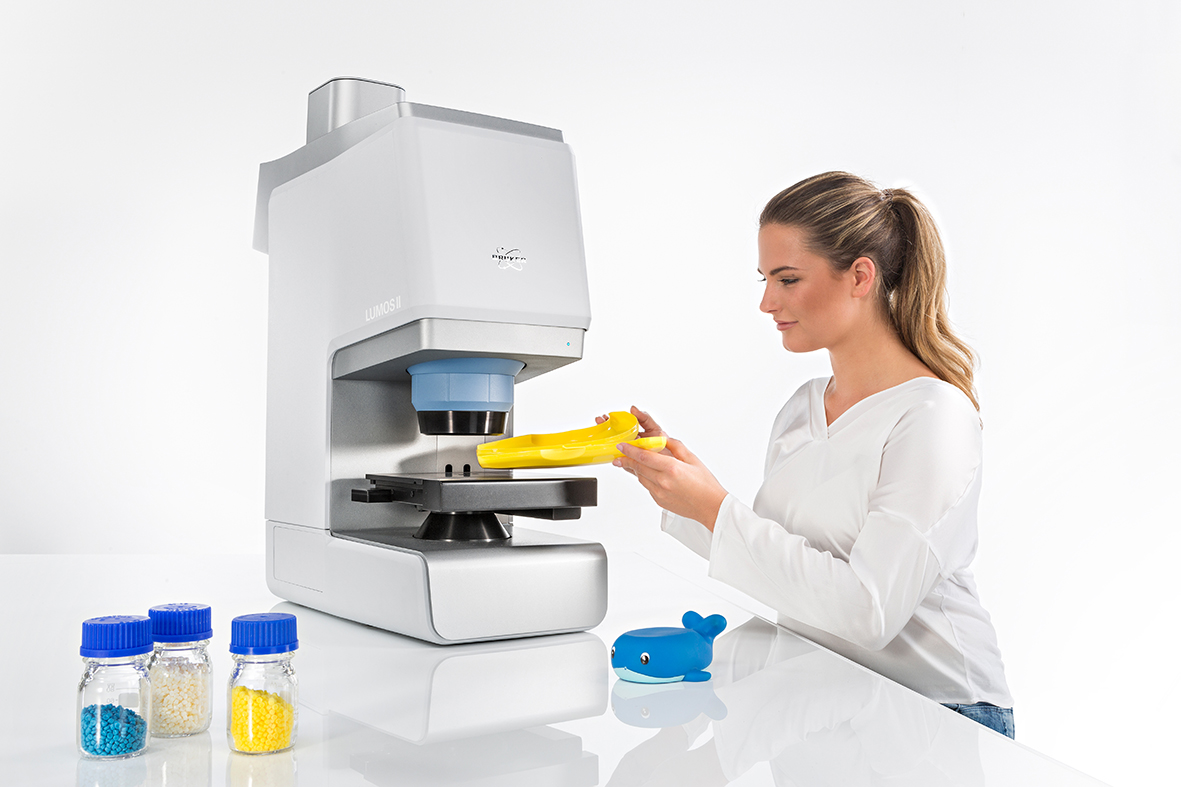
Key Features of the LUMOS II
- Automated Workflows: Streamlines data acquisition and processing.
- High-Resolution Imaging: Delivers detailed images of microplastic samples.
- Intuitive Software: Bruker's OPUS software simplifies data analysis and interpretation.
- Various Objectives: Offers flexibility for different sample types and sizes.
- External MCT Detector: High sensitivity for demanding applications.
Technical Specifications of LUMOS II
The LUMOS II works close to the diffraction limit of mid-infrared light. Bruker specifies the FPA imaging option at 1.25 µm spatial resolution in ATR mode, and Product Note M195 documents particles of 5 µm being reliably detected and identified from FT-IR imaging data at 5 µm pixel resolution. The often quoted figure of tens of micrometres belongs to point-by-point mapping, not to array imaging. High S/N ratio ensures accurate spectral data, even for trace amounts of microplastics. The system supports various sampling modes, including transmission, reflection, and ATR (Attenuated Total Reflectance).
Applications of LUMOS II in Microplastic Research
The LUMOS II finds applications in diverse areas of microplastic research. Researchers use it to analyze microplastics in water, soil, sediment, and biological tissues. The instrument aids in identifying the sources of microplastic pollution and assessing their impact on ecosystems. Quality control laboratories use LUMOS II to check the purity of polymers.
Identifying Polymer Types
The LUMOS II accurately identifies a wide range of polymer types commonly found as microplastics. This includes polyethylene (PE), polypropylene (PP), polystyrene (PS), polyvinyl chloride (PVC), and polyethylene terephthalate (PET). The OPUS software contains extensive spectral libraries for reliable polymer identification.
Quantifying Microplastic Abundance
Beyond identification, the LUMOS II helps quantify the abundance of microplastics in samples. By mapping the distribution of specific polymers, researchers can estimate the concentration of microplastics per unit area or volume. This quantitative data is crucial for assessing the severity of microplastic pollution.
Sample Preparation Techniques for FTIR Microscopy
Proper sample preparation is crucial for obtaining accurate and reliable results with FTIR microscopy. The appropriate method depends on the sample type and the nature of the analysis. Common techniques include filtration, density separation, and digestion. Always minimize contamination during sample preparation.
Analyzing Solid Samples
Solid samples, such as soil or sediment, often require pre-treatment to remove organic matter and isolate the microplastics. This can involve digestion with strong acids or bases. The remaining microplastics can then be filtered onto a suitable substrate for analysis.
Analyzing Liquid Samples
Liquid samples, such as water or wastewater, are typically filtered through a membrane filter with a defined pore size. The filter is then analyzed directly using FTIR microscopy. Ensure the filter material does not interfere with the IR spectrum of the microplastics.
The Future of Microplastic Research
Microplastic research is a rapidly evolving field. As analytical techniques improve, researchers will gain a better understanding of the sources, distribution, and impacts of microplastics. FTIR microscopy, particularly with instruments like the Bruker LUMOS II, will play a central role in these advances. These advances will help us develop effective mitigation strategies to protect our environment.
Conclusion
Microplastic pollution poses a significant environmental challenge. FTIR microscopy, especially when implemented with advanced instruments like the Bruker LUMOS II, provides a powerful tool for identifying, quantifying, and characterizing microplastics. By combining advanced instrumentation with robust data analysis techniques, researchers and environmental managers can gain critical insights into the extent and impact of microplastic contamination. These insights are essential for developing effective strategies to mitigate this growing environmental threat.
Ready to enhance your microplastic analysis capabilities? Contact Bruker today to learn more about the LUMOS II and other FTIR solutions.