
In-Situ Reaction Monitoring with an ALPHA II FT-IR
There is a moment in every synthesis where you stop the stirrer, draw a sample, quench it and walk it to the spectrometer. By the time the spectrum appears, the flask has moved on. In-situ reaction monitoring closes that gap. The probe sits in the mixture, the spectrometer records while the reaction runs, and nothing has to be removed from the vessel to find out what is happening in it.
Bruker now offers this as a snap-on module for the ALPHA II, the compact routine spectrometer that already sits on a great many benches in the Netherlands and Belgium. That detail is the whole point of this article. Reaction monitoring used to mean buying a second instrument. It does not any more.
What the module actually is
The INSITU-ATR reaction monitoring module, article number A260/D, is a QuickSnap module for the ALPHA II. The probe is a rigid, angle adjustable light pipe with a diamond ATR element at the tip. You clamp the spectrometer above the flask, point the probe down into the mixture, and record.
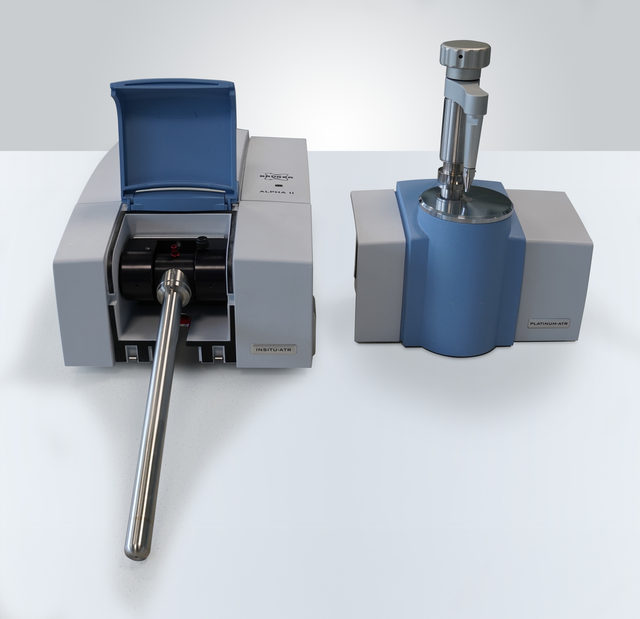
The physical specifications Bruker publishes for it:
- Probe body in 316 stainless steel, 22.7 cm long and 1.59 cm across
- Diamond ATR interface, chemically resistant and broadly applicable
- Adjustment range of 180 degrees, from vertically upwards to vertically downwards
- Spectral range 550 cm-1 to 4000 cm-1
Because it is a QuickSnap module it comes off without tools, and the spectrometer recognises and calibrates it automatically when it goes back on. The routine ATR module you use for incoming goods goes back on in seconds when the experiment is over.
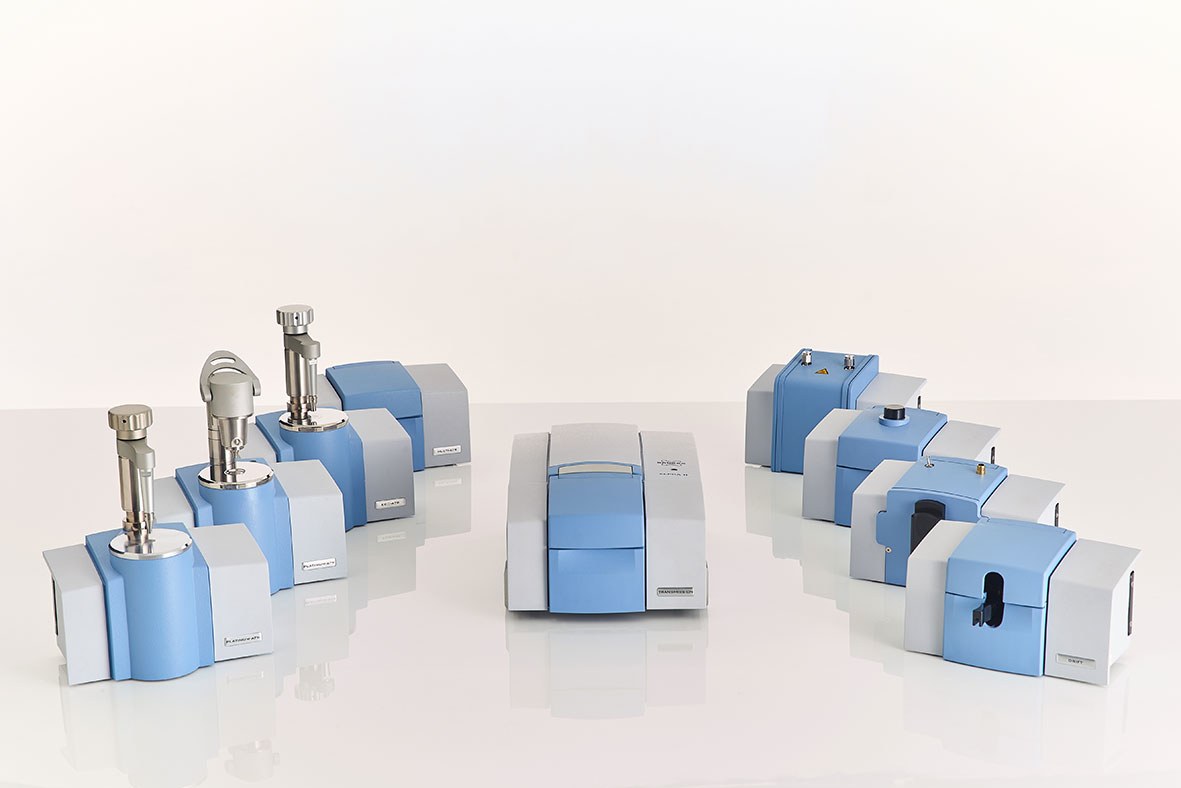
Bruker lists the package as the A250/DII ALPHA II base spectrometer, the A260/D sampling module, the reaction monitoring software O/RM, and the OPUS method creation and application suite O/IR9-M.
A saponification, followed for three hours
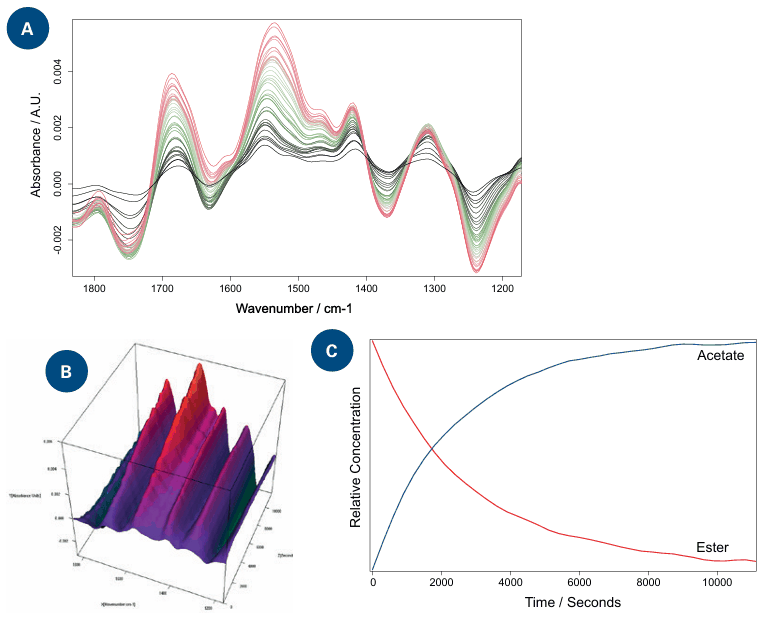
A published saponification shows what that looks like in practice. Ethyl acetate, sodium hydroxide, water and isopropyl alcohol were mixed to a homogeneous solution. The probe went straight into the mixture and a background was recorded at the start of the reaction.
The flask then sat on a magnetic stirrer at room temperature while spectra were collected automatically for about three hours. Two bands carried the evaluation: the band at 1686 cm-1 for the acetate that forms, and the band at 1240 cm-1 for the ester that disappears.
The result is worth dwelling on. The reaction is second order overall, but under these conditions it behaves as pseudo first order, and the data show it. A plot of the natural logarithm of the ester signal against time is linear, while a plot of the reciprocal signal is not. That is a kinetic conclusion drawn from the flask itself, not from a series of samples that each aged a little on the way to the instrument.
Note what you are left with afterwards. Not a trend line, but a full spectrum at every time point, which you can go back into when someone asks whether an intermediate appeared and then went away again.
Where it stops
An honest set of limits is more useful to you than a list of benefits, so here is where this module is the wrong answer.
- Pressure range is 0.1 mbar to ambient. A pressurised vessel is out of scope.
- Sample temperature runs from minus 80 degrees Celsius to 150 degrees Celsius. Above that, no.
- The pH window is 4 to 10. Strongly acidic or strongly alkaline media fall outside what Bruker specifies for it.
- ATR measures the liquid in contact with the crystal. A species has to be in solution and it has to have infrared bands. Headspace gases are a different measurement with different hardware.
There is a second practical limit that no data sheet states. Infrared sees functional groups, so the technique is at its best when reactant and product differ clearly in the fingerprint region. If the two look nearly identical in the mid infrared, follow something else, or follow the reaction by a band that changes indirectly.
The other way to do the same job
Immersion is not the only route. Bruker application note AN M111 describes the same ALPHA II with a temperature controlled diamond ATR and a flow-through cell, with the reaction medium pumped continuously over the crystal in a closed cycle. That setup reaches a temporal resolution of up to five seconds, and the temperature at the measurement element can be set between room temperature and 120 degrees Celsius.
The trade-off is straightforward. A flow cell brings a pump, tubing and dead volume, and the mixture leaves the vessel and comes back. The immersion probe brings none of that, but the spectrometer has to sit over the flask. Fast reactions and temperature ramps favour the flow cell. Everything else favours the probe.
Lab scale, and deliberately so
This is a bench module for a fume hood, not a process analyser. It is meant for the round-bottom flask where a route is being worked out, the reaction that is being scaled from grams to hundreds of grams, and the endpoint that currently gets called by eye or by a fixed clock.
If what you actually need is a probe in a production reactor, wired into the control room, that is a different family of instruments and a different conversation. Say so early and we will not waste your time on the wrong demo.
Why this matters if you already own an ALPHA II
Most labs that ask me about reaction monitoring assume it means a capital purchase and a new footprint. For an existing ALPHA II owner it usually means a module, a software licence and an afternoon of setup.
That changes who can justify it. A quality control instrument that runs identity checks in the morning becomes a kinetics instrument in the afternoon, in the same hood, with the same operators and the same software. The spectrometer is small enough to fit in the hood, which is the reason this works at all.
FAQ
Do I need a new spectrometer? No. The INSITU-ATR is a sampling module for the ALPHA II. Which configuration you have matters, so send me the instrument details and I will check it against what Bruker specifies.
Can I still run routine ATR afterwards? Yes. QuickSnap modules come off and go on without tools, and the instrument recognises and calibrates whichever module is fitted.
Can I use it in a pressure reactor? No. Bruker gives the pressure range as 0.1 mbar to ambient.
What about aggressive media? The diamond interface is chemically resistant, and the specified pH window is 4 to 10. Outside that window, ask before you dip.
Which software runs it? The reaction monitoring function in OPUS, supplied as O/RM, together with the OPUS method creation and application suite.
Bring me a reaction
My name is Savas Kaplan and I represent Bruker Optics in the Netherlands and Flanders. If reaction monitoring is on your list for this year, the useful next step is not a brochure.
Tell me the reaction you actually care about, the solvent, the temperature and roughly how fast it goes. We set it up on an ALPHA II with the INSITU-ATR, run it, and you see your own chemistry on the screen instead of somebody else's saponification. If the answer turns out to be that infrared cannot follow your reaction, I will tell you that too, and you will have saved yourself a purchase.