
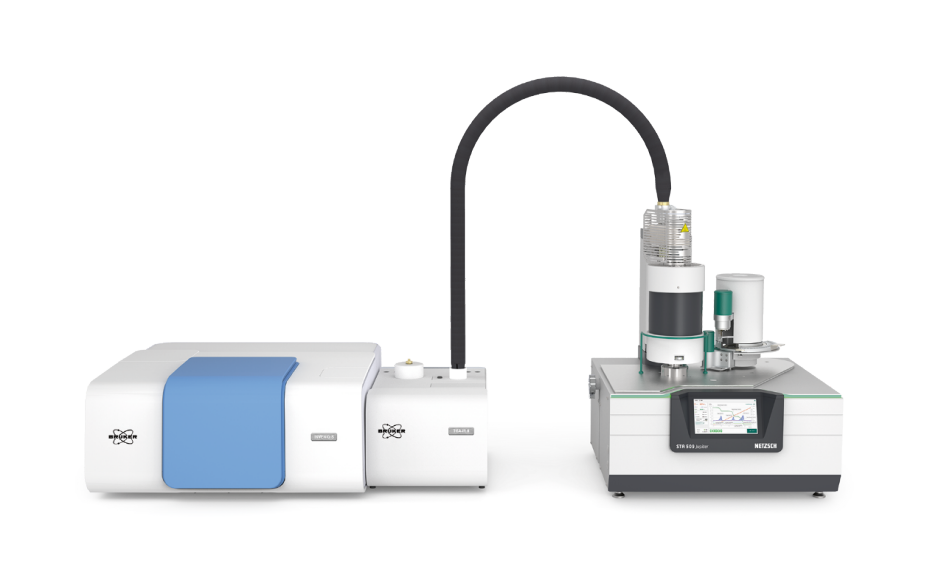
Product Overview
The Bruker TG-FTIR solution is a powerful hyphenated analytical technique designed for the advanced characterization of organic and inorganic materials. While standard thermogravimetric analysis (TG) precisely quantifies mass changes as a function of temperature, it cannot identify the chemical nature of the released substances. By coupling a TG analyzer, typically from Bruker’s long-standing partner NETZSCH, with a high-performance FT-IR spectrometer, researchers can identify gaseous decomposition products, plasticizers, and solvents in real-time as they are evolved from the sample.
The system utilizes a sophisticated gas cell design that balances long optical path lengths for high sensitivity with low internal volumes to prevent gas dilution. To ensure data integrity, the entire gas path is continuously heated up to 300°C to eliminate "cold spots" and prevent the condensation of heavy decomposition products. The integration between the Proteus® thermal analysis software and Bruker’s OPUS software allows for seamless, synchronized data acquisition, enabling users to correlate specific mass-loss steps directly with their corresponding infrared "fingerprint" spectra.
Product Demonstration
Key Features
- Simultaneous Analysis: Directly correlates quantitative mass-loss events with the definitive chemical identification of evolved gases.
- Optimized Gas Cell Design: Features beam-conforming metal gas cells with a mirror-free internal design to prevent particle condensation and sensitivity loss.
- Continuously Heated Interface: The entire transfer line and gas cell are heated up to 300°C to ensure the complete transport of even high-boiling decomposition products.
- Patented PERSEUS® Coupling: Offers a direct, transfer-line-free alliance between the ALPHA II spectrometer and the TGA furnace for a minimized footprint and maximum gas transfer efficiency.
- High-Sensitivity Detection: Can be equipped with room-temperature DLaTGS or liquid nitrogen-cooled MCT detectors to meet specific trace-gas detection requirements.
- Vacuum Compatibility: Supports measurements under reduced pressure to remove oxygen, lower boiling points, and eliminate carryover effects.
- Fully Integrated Software: Synchronized start/stop and live data exchange between Proteus® and OPUS software for streamlined analytical workflows.
- Automated High-Throughput: Compatible with automatic sample changers (ASC) for unattended analysis of large sample batches.
Specifications
| Max. Interface Temp. | Up to 300°C (Adapter) / 230°C (Transfer Line) |
| Gas Cell Path Length | 123 mm (External/Internal) / 70 mm (PERSEUS®) |
| Gas Cell Volume | 8.7 ml (External/Internal) / 5.8 ml (PERSEUS®) |
| Coupling Modes | External Gas Cell, Internal Gas Cell, or Direct PERSEUS® |