
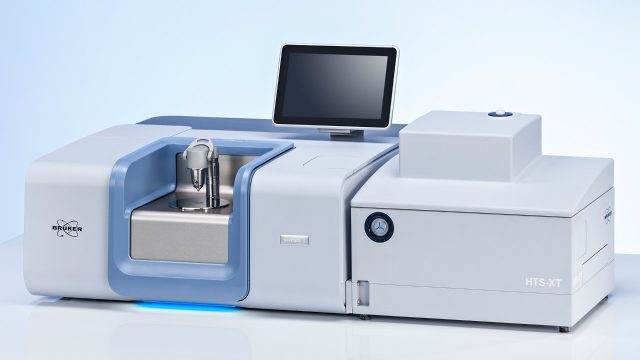
Product Overview
The Bruker HTS-XT is an advanced high-throughput screening extension designed to automate the acquisition and evaluation of spectral data for large sample populations. Unlike traditional screening methods that require specific marker systems or labels, the HTS-XT utilizes the inherent molecular "fingerprint" provided by infrared spectroscopy. This allows researchers to perform label-free, parallel determination of multiple structural and chemical parameters in a single measurement, significantly increasing laboratory efficiency in fields ranging from microbiology to polymer science.
The system is engineered as an external module that integrates seamlessly with Bruker’s research-grade spectrometers, supporting measurements across the Mid-Infrared (MIR), Near-Infrared (NIR), and even the Visible (VIS) ranges. Samples are simply loaded onto standardized 96-, 384-, or 1536-well microplates and moved into the sealed optics via a motorized drawer. Controlled by the intuitive OPUS/LAB software, the HTS-XT automatically scans each well in transmission or diffuse reflection mode, enabling unattended routine analysis and high-precision quantification through sophisticated multivariate algorithms.
Key Features
- Massive Sample Throughput: Fully automated measurements supporting standard 96-, 384-, and 1536-well microplate formats for maximum productivity.
- Label-Free Analysis: Provides extensive structural and molecular information without the need for expensive markers or specific staining systems.
- Multi-Spectral Versatility: Can be configured for the Mid-IR, Near-IR, or VIS range depending on the connected spectrometer.
- Advanced Evaluation Software: Utilizing OPUS/LAB for streamlined data acquisition and powerful qualitative and quantitative evaluation.
- Robust Sampling Modes: Supports both automated transmission and diffuse reflection measurements to accommodate a wide variety of sample types.
- Reusable Plate Technology: Uses easy-to-clean, reusable microplates that reduce operational costs and waste.
- LIMS Integration: Automated storage of parameters and results in logfiles facilitates easy data transfer to external Laboratory Information Management Systems.
Specifications
| Microplate Formats: | 96-, 384-, or 1536-well standardized formats. |
| Measurement Modes: | Transmission and/or Diffuse Reflection. |
| Spectral Range Compatibility: | MIR, NIR, and VIS (spectrometer dependent). |
| Sample Volume (Liquid): | Typically 1–20 µl per well. |
| Automation: | Motorized drawer for sample plate loading and automated X-Y stage for well-to-well scanning. |
| Application Scope: | Microbiology, soil analysis, biological fluids, and polymer kinetics. |