
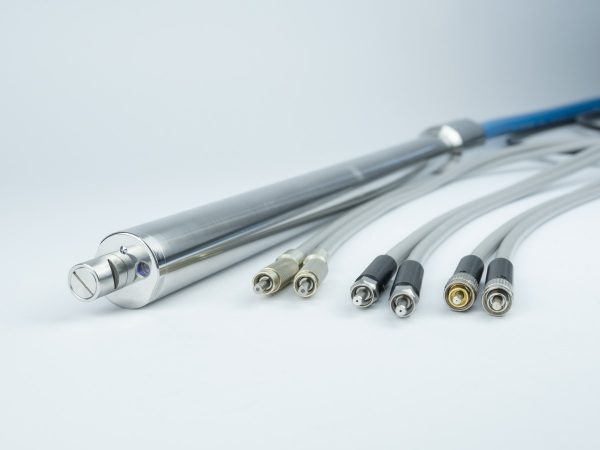
Product Overview
Art Photonics Transflection Fiber Probes combine the benefits of transmission and reflection spectroscopy. The probe features a gap through which the sample flows; light travels from the source fiber, through the sample, reflects off a high-quality mirror, and travels back through the sample to the collection fiber. This "double-pass" geometry effectively doubles the interaction pathlength, making these probes highly sensitive for low-concentration liquids and clear solutions.These probes are particularly popular for Near-Infrared (NIR) and UV-Vis applications. The fixed or adjustable pathlength gap allows for precise quantification according to the Beer-Lambert law. The industrial version features a robust, sanitary design, often including 3A certification for the food and dairy industries, ensuring it can be used in sterile environments for monitoring milk fat, protein levels, or chemical blending processes
Key Features
- High Sensitivity: Double-pass design provides an effective pathlength twice the physical gap.
- Adjustable Pathlength: Gap can be tuned (e.g., 1 mm to 10 mm) for different concentrations.
- Broad Spectral Range: Options available for UV (200 nm) to Near-IR (2500 nm).
- No Alignment Required: Rugged internal mirror ensures stable performance in high-vibration environments.
- Sanitary Options: 3A-certified and CIP (Clean-In-Place) compatible designs.
Specifications
| Spectral Range | 200 nm – 2500 nm |
| Body Material | Stainless Steel 316L / Hastelloy |
| Max Temperature | 200°C |
| Pressure Rating | Up to 100 bar |